

Infant Behavior Video Analysis using Pose Estimation and Action Recognition
Pose Estimation 및 Action Recognition 기반 영유아 행동 분석 모델 및 활용 제안
아동의 성장 과정에서 대근육 발달은 신경 발달 상태를 보여주는 핵심적인 지표입니다. 기존의 발달 검사(예: 베일리, 웩슬러 영유아 발달검사)는 고비용이며 임상 전문가가 대면으로 관찰해야 하므로 시간과 공간의 제약이 큽니다.
본 프로젝트에서는 컴퓨터 비전의 핵심 기술인 Pose Estimation(자세 추정) 및 Action Recognition(행동 인식) 모델을 결합하여, 집에서 간단히 촬영한 행동 영상만으로 영유아의 발달 상태를 정밀하게 평가하고 예측하는 인공지능 기반 분석 모델 파이프라인을 제안합니다.
1. 프로젝트 요약 슬라이드
아래 슬라이드는 대학원 재학 중 수행한 영유아 행동 영상 데이터 활용 아이디어 설명서의 세부 장표들입니다.
2. 목표 설정 및 데이터 분석
우리의 주 목표는 두 가지입니다:
- 정확한 Pose Estimation을 통한 아동의 관절 움직임 정밀 분석
- Action Recognition 기술을 통한 아동의 대근육 운동 발달 수준(또래 수준, 빠른 수준 등) 예측
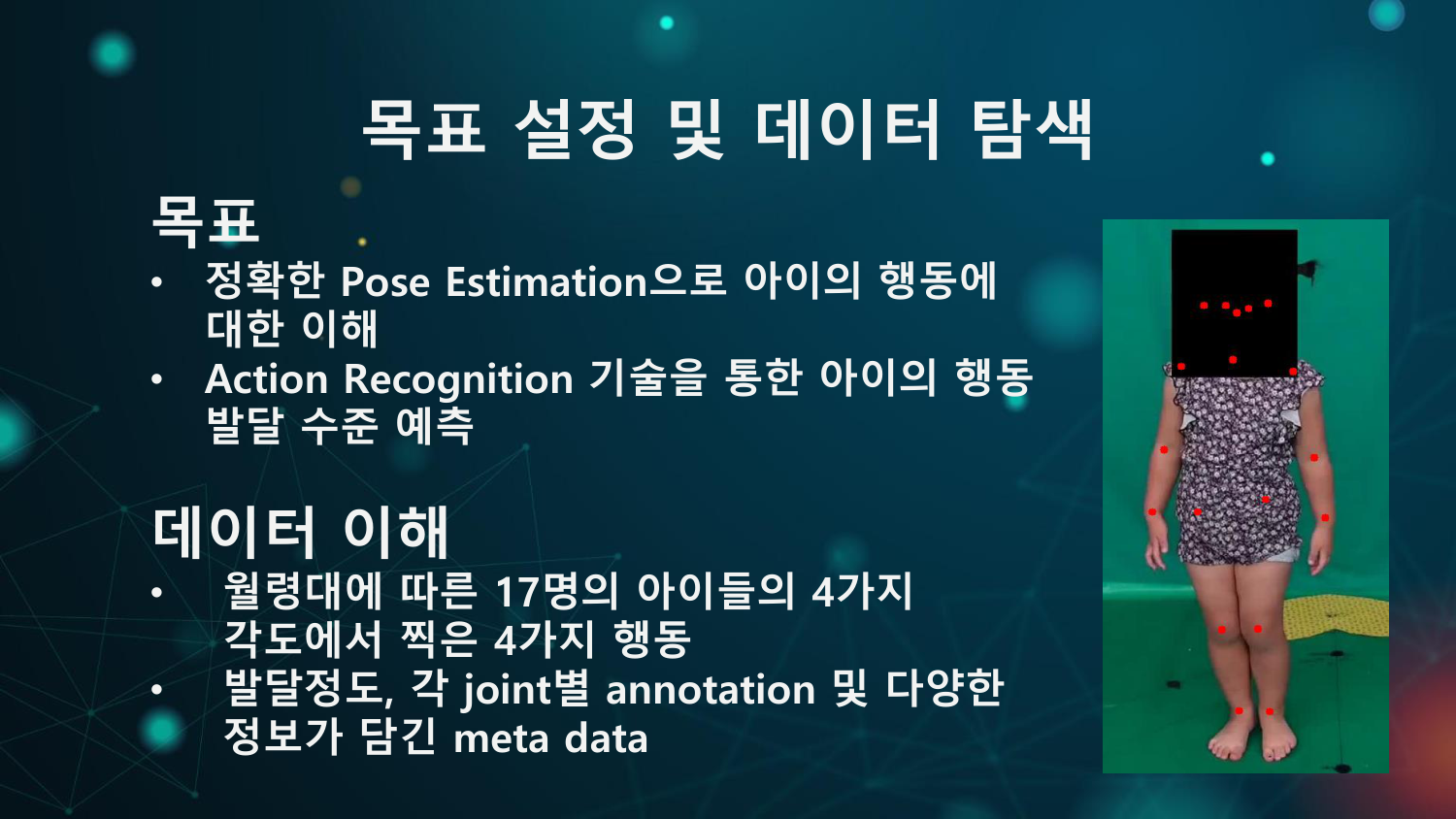
- 데이터셋 구성: 다양한 월령대의 아이들 17명을 대상으로, 4가지 촬영 각도에서 측정된 4가지 주요 대근육 행동(공 세우기, 줄 넘기 등) 동영상. 각 프레임별 관절(Joint) 어노테이션 정보 및 발달 단계 메타데이터 포함.
3. 2D Pose Estimation: DC Pose
영유아의 불규칙하고 빠른 움직임을 추정할 때 발생하는 떨림(Jittering) 현상을 해결하기 위해, 프레임 간 시공간 정보를 통합하는 DC Pose(Deep Dual Consecutive Network)를 적용했습니다.
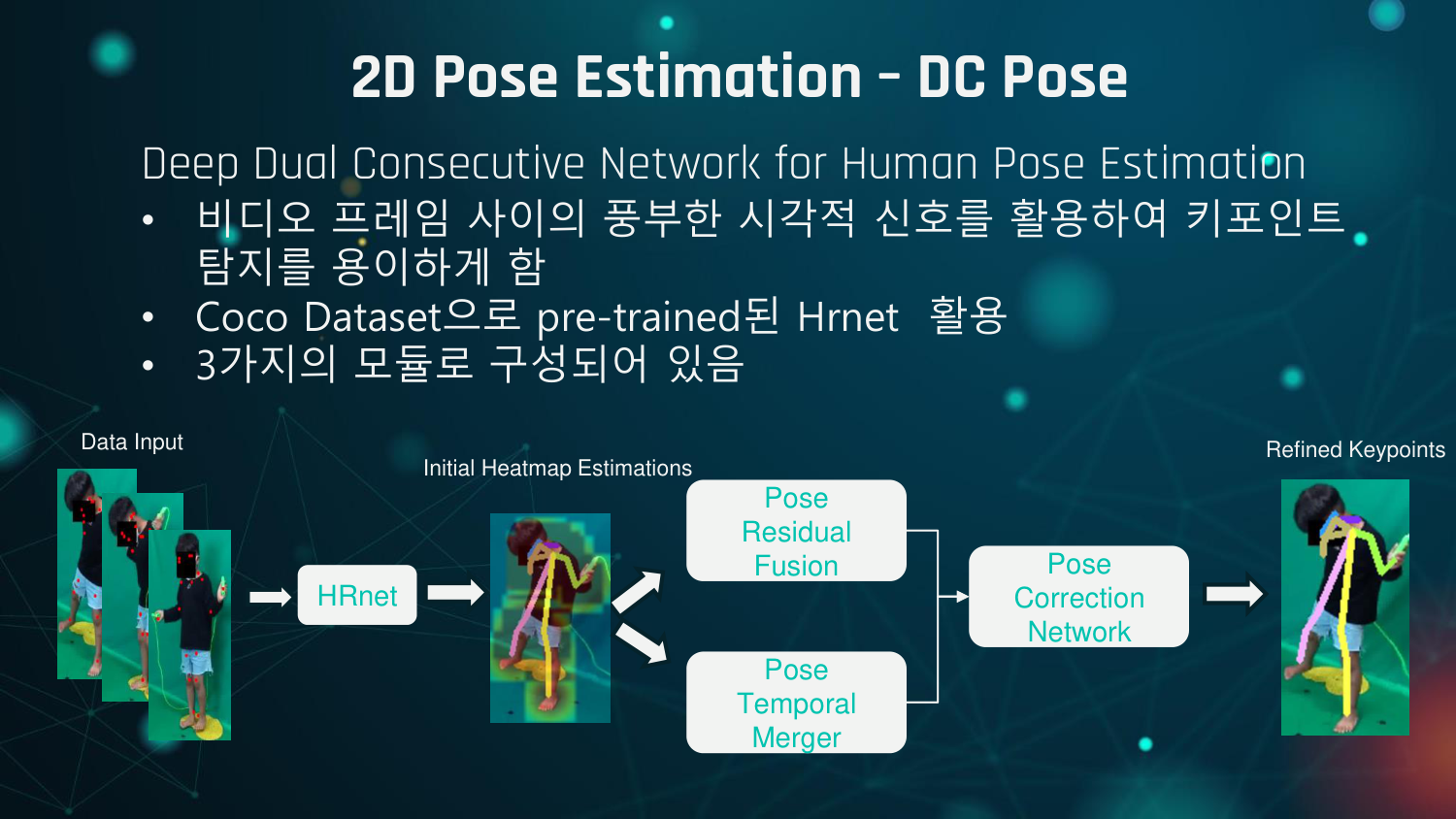
- 백본: COCO Dataset으로 사전 학습된 HRNet을 기본 구조로 채택하여 고해상도 특징 맵 유지.
- 시공간 모듈:
- Pose Residual Fusion: 연속된 프레임 간의 잔차를 학습하여 가려짐(Occlusion)이나 모션 블러 구간 보정.
- Pose Temporal Merger: 프레임 흐름 간의 시간적 정보를 압축 결합.
- Pose Correction Network: 오추정된 키포인트를 최종 보정.
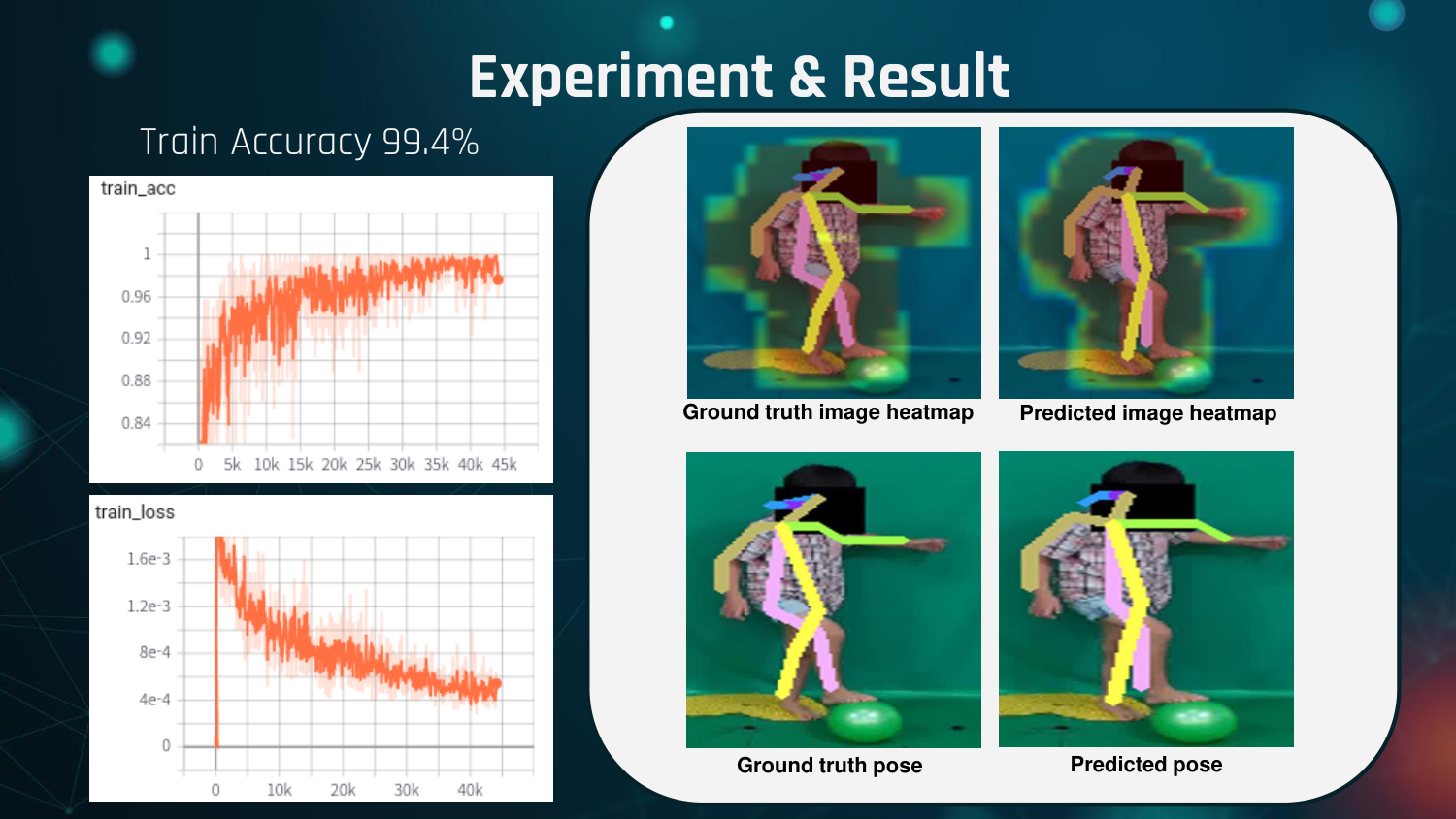
- 실험 결과: 관절 히트맵 예측 결과 99.4%의 Train Accuracy를 달성하며 매우 정밀한 뼈대 복원에 성공했습니다.
4. Action Recognition: I3D
영상이 주어졌을 때 영유아가 어떠한 발달 수준의 행동을 보이는지 판별하기 위해 3차원 합성곱 신경망인 I3D (Inflated 3D Convolutional Network)를 활용했습니다.
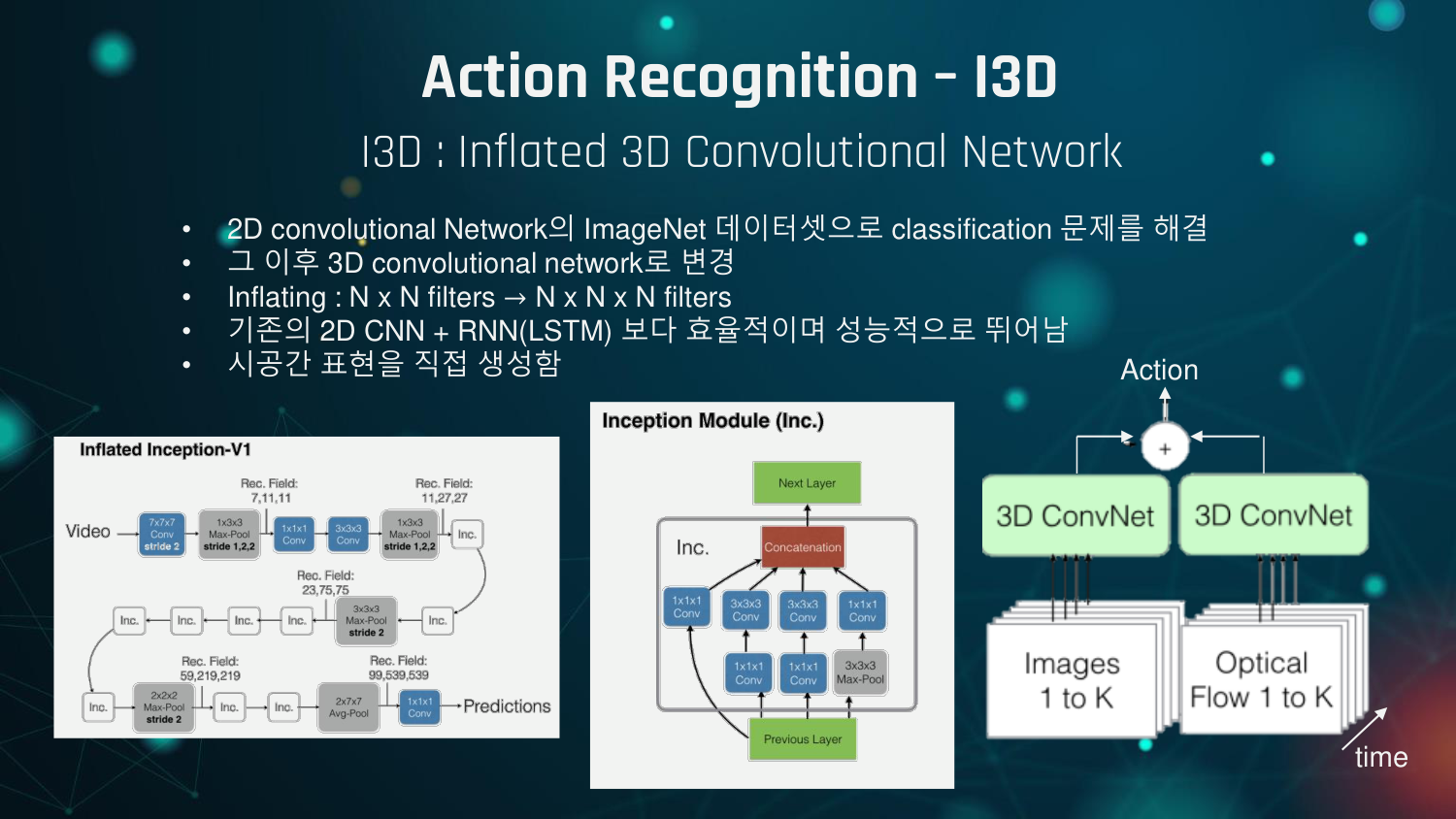
- 핵심 원리: 잘 훈련된 2D CNN(ImageNet으로 학습된 Inception-V1)의 가중치를 시간 축으로 팽창(Inflating)시켜 3D 필터($N \times N \times N$)로 확장 적용.
- 장점: 기존의 2D CNN + LSTM 구조에 비해 시공간적(Spatio-temporal) 특징을 직접 표현할 수 있어 비디오 행동 인식 분야에서 성능이 탁월함.
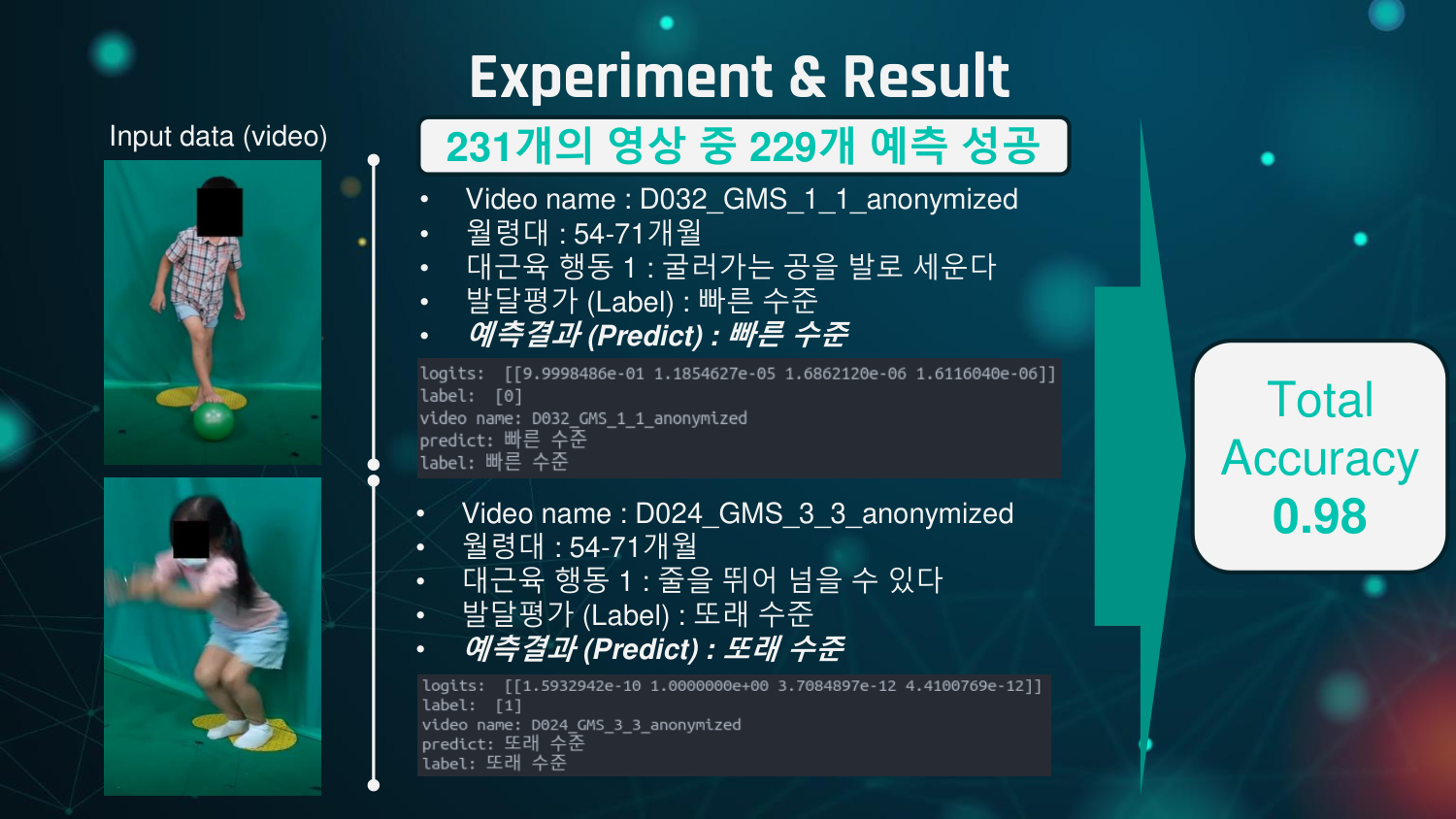
- 실험 결과: 총 231개의 발달 행동 검증용 영상 중 229개를 맞추며 98%의 최종 분류 정확도(Total Accuracy 0.98)를 얻었습니다.
5. 결론 및 실무 활용방안
이 기술은 원격 영유아 케어 서비스 및 사고 예방 분야로 확장 가능합니다.
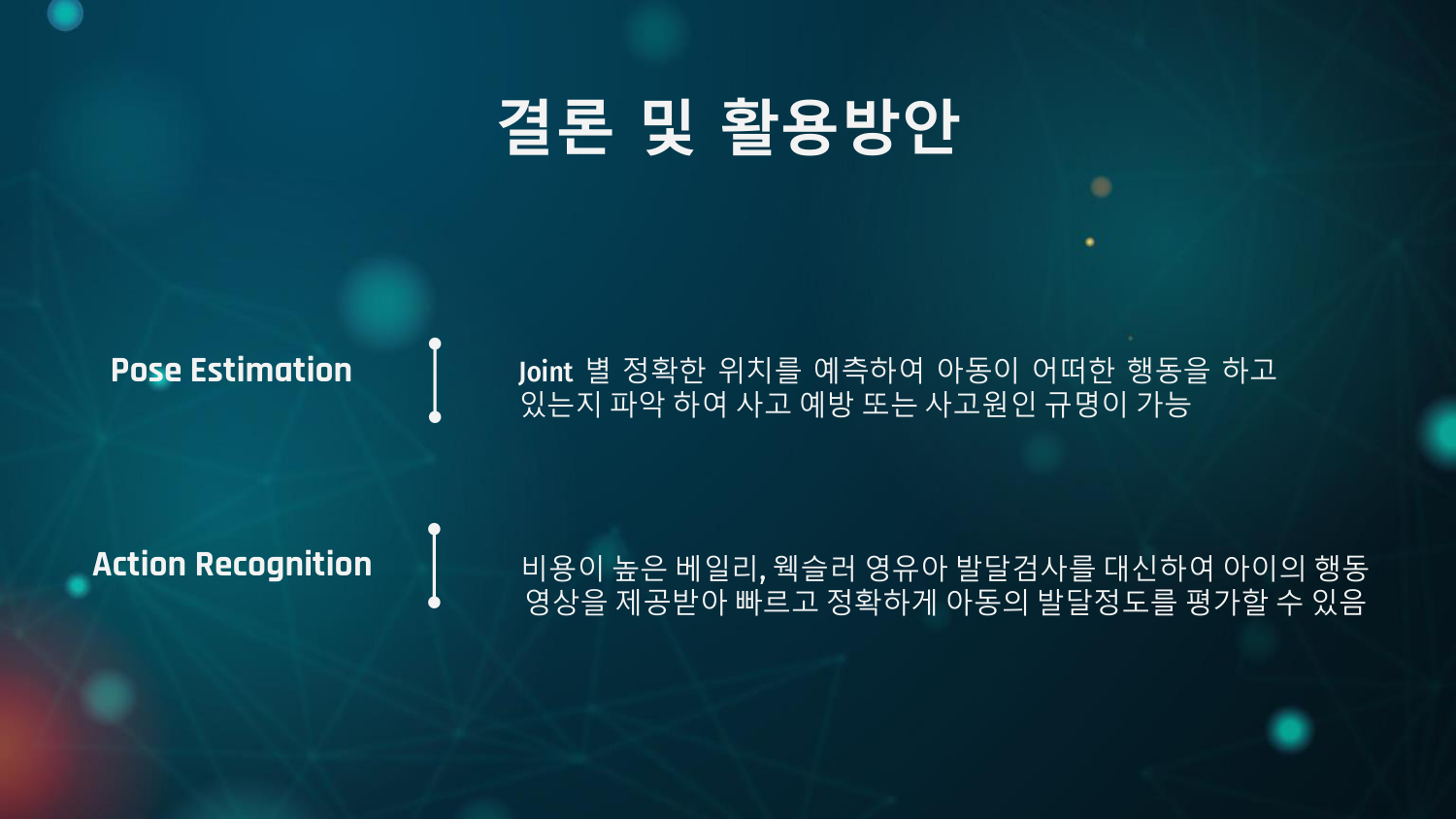
- 자세 분석을 통한 위험 예방: 영아의 관절 위치 변화 속도를 실시간 추정하여 낙상, 뒤집기 질식 등의 위험 상황을 탐지하거나 사고 원인을 사전에 규명할 수 있습니다.
- 비대면 아동 발달 스크리닝: 병원을 방문하기 힘든 가정에서도 모바일 앱 등으로 촬영한 영유아의 일상 운동 놀이 영상을 통해 베일리 발달검사 등을 대체할 수 있는 신뢰성 높은 1차 발달 평가 리포트를 받아볼 수 있습니다.
Infant Behavior Video Analysis using Pose Estimation and Action Recognition
Gross motor skill development in early childhood serves as a critical biomarker for neurodevelopmental health. Conventional evaluation tools, such as the Bayley Scales of Infant Development, are expensive and require in-person observation by clinical experts, which limits accessibility.
This project proposes an artificial intelligence pipeline that combines Pose Estimation and Action Recognition to precisely evaluate and predict infant motor development using everyday videos recorded at home.
1. Project Summary Slides
The slides below present the detailed proposal for using infant behavior video datasets, developed during my graduate studies.
2. Goals & Data Analysis
We set two main objectives:
- Joint-level precision tracking using Pose Estimation
- Predicting developmental stages (e.g., advanced vs. typical age levels) using Action Recognition
- Dataset: Video records of 17 infants at different developmental stages, recorded from 4 camera angles during 4 gross motor tasks (e.g., stopping a rolling ball, jumping rope). Ground truth joint annotations and developmental stage metadata are included.
3. 2D Pose Estimation: DC Pose
To prevent joint jittering caused by infants’ rapid, irregular movements, we adopted DC Pose (Deep Dual Consecutive Network), which integrates spatial-temporal information across consecutive frames.
- Backbone: Uses a HRNet pre-trained on the COCO Dataset to maintain high-resolution feature maps.
- Spatiotemporal Modules:
- Pose Residual Fusion: Learns motion residuals to correct occlusion and motion blur.
- Pose Temporal Merger: Aggregates temporal cues across consecutive frames.
- Pose Correction Network: Refines misaligned joint predictions.
- Results: Achieved a Train Accuracy of 99.4%, demonstrating highly precise keypoint regression.
4. Action Recognition: I3D
To categorize the motor coordination level of the infant’s movements, we utilized the I3D (Inflated 3D Convolutional Network).
- Core Principle: Extends pre-trained 2D Inception-V1 filters into 3D filters ($N \times N \times N$) along the temporal dimension.
- Advantages: Captures spatiotemporal features directly, outperforming hybrid 2D CNN + LSTM architectures in video recognition tasks.
- Results: Successfully predicted developmental categories for 229 out of 231 validation clips, achieving a Total Accuracy of 0.98.
5. Conclusion & Potential Applications
This technology can be applied to remote child care services and home safety systems.
- Accident Prevention: Real-time velocity tracking of infant joints can help detect dangerous events (e.g., rollover suffocation, falls) or analyze the causes of accidents.
- Non-contact Screening: Allows parents to upload videos of home play tasks to receive highly reliable preliminary screening reports, reducing the cost and accessibility barriers of traditional face-to-face clinic visits.